
Malawi introduced a reciprocity-based visa system in December 2025, splitting countries into two categories. Category Two nationals can obtain a visa on arrival at designated ports of entry by paying in cash (USD). Category One nationals must secure an eVisa before departure. Below is everything you need to know about eligibility, costs, documents, and the step-by-step process at the airport.
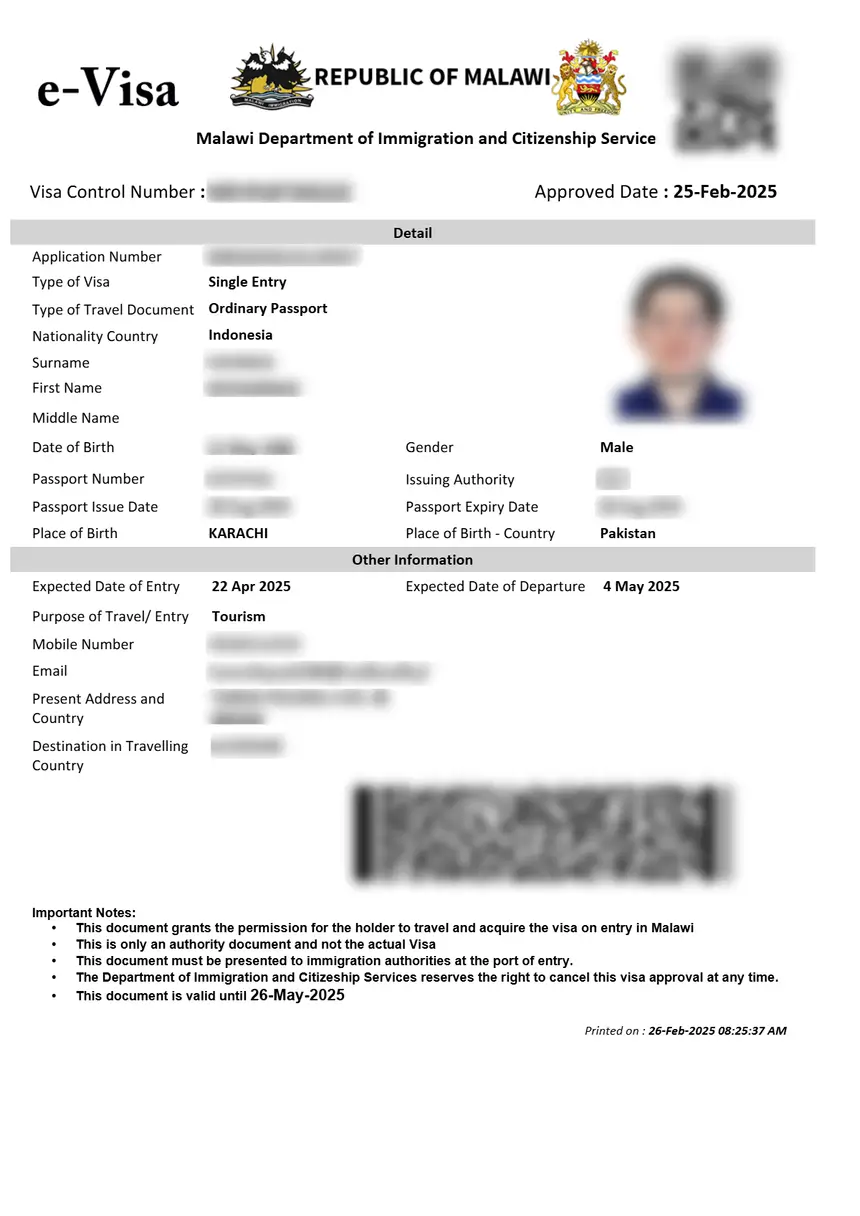
What Is the Malawi Visa on Arrival?
The Malawi visa on arrival is a single-entry visa issued at the port of entry to citizens of countries classified under Category Two of Malawi’s reciprocity-based visa policy. It allows eligible travelers to receive their visa stamp immediately upon landing without having to apply online beforehand.
This option is available at major entry points including Kamuzu International Airport in Lilongwe, Chileka International Airport in Blantyre, and selected land border crossings.
Updated in February 2026, the Malawi government confirmed that Category Two nationals are explicitly permitted to board flights without a pre-arranged visa, removing any airline check-in confusion.
Category Two Countries: Who Can Get a Visa on Arrival?
Under the December 2025 reciprocity system, Malawi classifies countries into two groups. Category Two countries are those whose nationals may apply for a visa on arrival. While the complete official list is maintained on the evisa.gov.mw portal, the following countries are generally included:
| Region | Countries Eligible for Visa on Arrival |
|---|---|
| Europe | Most EU/EEA member states, United Kingdom, Switzerland |
| Americas | United States, Canada, Brazil, Argentina, Mexico |
| Asia-Pacific | China, Japan, South Korea, Australia, New Zealand |
| Middle East | United Arab Emirates, Saudi Arabia, Turkey |
| Other | Russia, India, Pakistan, Bangladesh, Nigeria |
Important: Always verify your country’s eligibility using the Visa Eligibility Wizard on the official portal, as classifications may change.
Category One Countries: Visa on Arrival NOT Available
Category One countries are those whose nationals must obtain an eVisa before traveling to Malawi. There is no visa on arrival option for these nationalities. If you are from a Category One country and arrive without a valid eVisa, you will be denied entry.
Check the current classification of your country on evisa.gov.mw before booking your flight.
Visa-Exempt Countries: No Visa Needed
Before checking visa on arrival eligibility, confirm whether your country is visa-exempt. Citizens of approximately 40+ countries can enter Malawi without any visa for stays of up to 90 days. These include:
- All SADC member states: South Africa, Tanzania, Zambia, Zimbabwe, Mozambique, Botswana, Namibia, Eswatini, Lesotho
- Select COMESA members: Kenya, Rwanda, Uganda, Egypt, Mauritius
- Others: Hong Kong, Singapore, Israel, Malaysia, Philippines, Jamaica, Barbados, Trinidad and Tobago, Bahamas, Fiji, and several Caribbean and Pacific Island nations
If your country is visa-exempt, you do not need a visa on arrival or an eVisa. For a full breakdown, see our guide to Malawi visa-free countries.
Malawi Visa on Arrival Fees
All visa fees in Malawi are quoted in US Dollars (USD). The same fee structure applies regardless of nationality – there are no reciprocal pricing differences.
| Visa Type | Fee (USD) | Validity | Entries |
|---|---|---|---|
| Transit Visa | $50 | Up to 7 days | Single |
| Single-Entry Tourist Visa | $75 | Up to 90 days | Single |
| 6-Month Multiple Entry | $150 | 6 months | Multiple |
| 12-Month Multiple Entry | $250 | 12 months | Multiple |
Payment at the port of entry is accepted in cash USD only. Credit and debit cards are not accepted at the visa-on-arrival counter. Make sure to carry clean, undamaged US dollar bills.
Note: Some travelers report that the on-arrival fee for a single-entry visa may be $50 at certain land borders, while the eVisa fee is $75. This discrepancy may reflect different pricing for in-person vs. online applications. Verify current fees before travel.
For a detailed cost comparison, see our complete Malawi visa fees guide.
Documents Required at the Port of Entry
To obtain a visa on arrival, you must present the following documents to the immigration officer:
- Valid passport – must be valid for at least 6 months from your date of arrival and have at least one blank page for the visa stamp
- Return or onward ticket – proof that you intend to leave Malawi before your visa expires
- Proof of accommodation – hotel booking, invitation letter, or host’s address in Malawi
- Sufficient funds – evidence you can support yourself during your stay (bank statement, cash, or credit cards)
- Yellow fever certificate – required if you are arriving from or transiting through a yellow fever endemic country
- Completed Traveller Health Check form – available at poe.health.gov.mw/self-screen or via QR code at the airport
- Cash USD – exact amount for your chosen visa type
For a comprehensive checklist, review our Malawi visa requirements guide.
Step-by-Step Process at the Airport
Here is exactly what to expect when applying for a Malawi visa on arrival:
- Arrive at the port of entry – disembark and follow signs to immigration
- Collect a visa application form – available at the immigration desk or a dedicated visa-on-arrival counter
- Fill out the form – provide your personal details, passport information, purpose of visit, and accommodation address
- Join the visa-on-arrival queue – separate from the queue for visa-exempt travelers and eVisa holders
- Submit documents – hand your completed form, passport, supporting documents, and cash payment to the immigration officer
- Wait for processing – the officer reviews your application, stamps your passport, and returns it with the visa
- Proceed through immigration – after receiving your visa stamp, continue to baggage claim and customs
The entire process typically takes 15 to 45 minutes, depending on the number of arrivals. During peak travel periods, expect longer waits.
Visa on Arrival vs. eVisa: Which Should You Choose?
Both pathways lead to the same visa, but they differ in convenience and preparation:
| Factor | Visa on Arrival | eVisa |
|---|---|---|
| Application time | At the airport | 4+ business days in advance |
| Payment method | Cash USD only | Credit/debit card online |
| Preparation needed | Carry documents + cash | Upload scanned documents online |
| Risk of denial | Possible at border | Approved before travel |
| Convenience | Queue at airport | Walk through eVisa lane |
| Recommended for | Spontaneous travel | Planned trips |
Applying for the Malawi eVisa online in advance is generally recommended because it eliminates uncertainty at the border. However, the visa on arrival is a reliable option for Category Two nationals who prefer flexibility.
Designated Ports of Entry for Visa on Arrival
The visa on arrival is available at the following official entry points:
Airports:
– Kamuzu International Airport (LLW) – Lilongwe
– Chileka International Airport (BLZ) – Blantyre
Land Borders:
– Mwanza (Mozambique border)
– Songwe (Tanzania border)
– Mchinji (Zambia border)
– Dedza (Mozambique border)
– Mulobezi (Zambia border)
Not all smaller border posts process visa on arrival applications. If entering via a minor crossing, consider obtaining your eVisa in advance to avoid delays. See our Malawi visa types overview for more details.
Processing Time and What to Expect
There is no pre-processing time for a visa on arrival – it is issued immediately at the counter. However, the overall time you spend at immigration depends on:
- Queue length – international flights arriving simultaneously increase wait times
- Document completeness – missing documents cause delays or denial
- Officer discretion – additional questions may be asked about your trip purpose
For comparison, the Malawi eVisa processing time is a minimum of 4 business days, though it can take longer during peak periods.
Common Mistakes to Avoid
Avoid these frequent errors that cause problems at the border:
- Arriving without cash USD – card payments are not accepted at the visa-on-arrival counter
- Insufficient passport validity – your passport must be valid for 6+ months, not just until your departure date
- Missing yellow fever certificate – required if arriving from or transiting through an endemic country, including Kenya, Ethiopia, and Tanzania
- Incorrect visa type – transit visas ($50) are only valid for 7 days; overstaying requires a new visa
- Damaged or torn US dollar bills – immigration officers may reject bills that are heavily worn, marked, or torn
- No accommodation proof – hotel booking or host address is required
Frequently Asked Questions
Can I get a Malawi visa on arrival as a US citizen?
Yes. US citizens are classified under Category Two and can obtain a visa on arrival at designated ports of entry. The single-entry tourist visa costs $75 (cash USD). Alternatively, US citizens can apply for the eVisa online in advance. For more details, see our guide on [Malawi visa requirements](https://evisa-malawi.info/malawi-visa-requirements/).
How much does a Malawi visa on arrival cost?
The single-entry tourist visa on arrival costs $75 USD (cash only at the border). A transit visa is $50, a 6-month multiple entry visa is $150, and a 12-month multiple entry visa is $250. All fees are the same regardless of nationality.
What currency should I bring for the visa on arrival?
Bring US Dollars (USD) in cash. Credit cards and debit cards are not accepted at the visa-on-arrival counter. Ensure your bills are clean, undamaged, and in good condition.
Do Indian citizens need a visa to enter Malawi?
Yes. Indian citizens need a visa. India is classified as a Category Two country, so Indian nationals can obtain a visa on arrival at designated ports of entry. They can also apply for an eVisa online in advance. See our dedicated guide on [Malawi eVisa for Indian citizens](https://evisa-malawi.info/malawi-evisa-indian-citizens/).
Can I board my flight to Malawi without a pre-arranged visa?
If you are from a Category Two country, yes. The Malawi government confirmed in February 2026 that Category Two nationals are explicitly permitted to board flights without a pre-arranged visa. Category One nationals must have an approved eVisa before departure.
What happens if I arrive from a Category One country without an eVisa?
You will be denied entry. Category One nationals must obtain an eVisa before traveling. There is no visa-on-arrival option for Category One countries. Always verify your country’s classification on the official eVisa portal.
Is the visa on arrival available at all border crossings?
No. Visa on arrival is available at major airports (Lilongwe and Blantyre) and select land border posts. Smaller crossings may not process visa-on-arrival applications. If entering via a minor border post, apply for the eVisa online in advance.
How long can I stay in Malawi with a visa on arrival?
A single-entry tourist visa allows stays of up to 90 days. A transit visa is valid for up to 7 days. Multiple-entry visas allow stays of up to 6 or 12 months depending on the visa type.